Muscle activations produce animation through muscle poses, which are built out of the character’s animation targets. When a muscle is activated, the corresponding muscle poses are scaled in. The animation of the character is thus the weighted sum of all of the muscle poses (or more accurately, the weighted sum of the deltas between the muscle poses and the neutral pose.)
Standard muscles
Standard muscles each have their own poses. In the simplest case, each muscle drives a single pose. For example, the muscle mouth_stretch has a single pose, which looks like this:

However, muscles can also be bidirectional. A bidirectional muscle has two poses rather than one: a positive pose and a negative pose. For example, the birdirectional muscle mouth_swing has these two poses.

The two poses of a bidirectional muscle are always opposite and mutually exclusive.
Note that when setting up a bidirectional muscle, the negative pose is automatically the inverse of the positive pose, unless a specific negative pose is provided.
Precision muscles
Precision muscles are a set of core muscles that work in combination to achieve precise, systematic behaviors, including speech and blinking. Collectively, the poses driven by the precision muscles are called the base poses. Due to the extra precision requirements, base poses are highly prescriptive, and they are more numerous because they are contextualized. See Overview of Precision Muscles for more information.
Setup guidelines
One may use any number of different animation targets to make a single pose. This may include joint translations and rotations, blendshape weights, or higher-level control displacements. Think of the animation targets as the tools for sculpting the muscle pose.
There does not need to be a one-to-one relationship between muscle poses and rig controls.
When defining a muscle pose there are four key objectives to keep in mind:
-
isolate the pose
-
maximize the pose detail
-
maximize the pose range
-
minimize the pose complexity
Isolate the pose
The first key objective is isolation. A muscle pose should capture the effect of one independently controllable muscle contraction, without mixing in the effects of other muscles. This differentiates muscles from more complex events that occur through cooperation between muscles, such as facial expressions.
Failing to isolate muscles can have these negative side-effects:
-
It limits the degrees of freedom of the character, since it prevents moving things separately.
-
It yokes anatomical parts together in ways that do not respect their individual dynamic properties and can thus defy what is physically possible.
Maximize the pose detail
While isolating muscle movements is important, it is also important to capture the entire effect of a muscle, which means maximizing both detail.
Naturalness lives in the details. And since muscles are the building blocks of animation, highly detailed muscle deformations are essential to natural-looking animation.
Detailed deformations require attention to all parts of the face that move with a particular muscle contraction, including small secondary movements. For example, when a person’s upper lip moves, the cheeks and nose area often get affected too. It’s important to include these secondary movements to reconstruct the full natural deformation. This is particularly important to keep in mind with bone rigs, where highly local deformations are possible and one could be tempted to focus on only one piece of anatomy.
Maximize the pose range
The third key to defining muscle poses is maximizing range. The muscle pose should represent the most extreme extent to which a real human could contract the muscle. For example, when defining the pose for nose_wrinkle_L, the version on the left is good, but the one on the right is too weak.
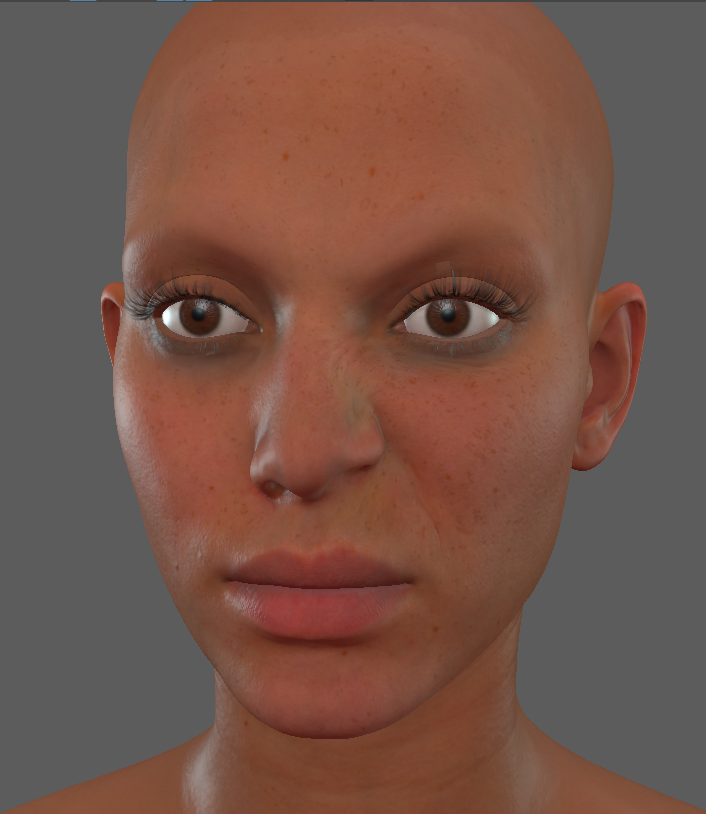
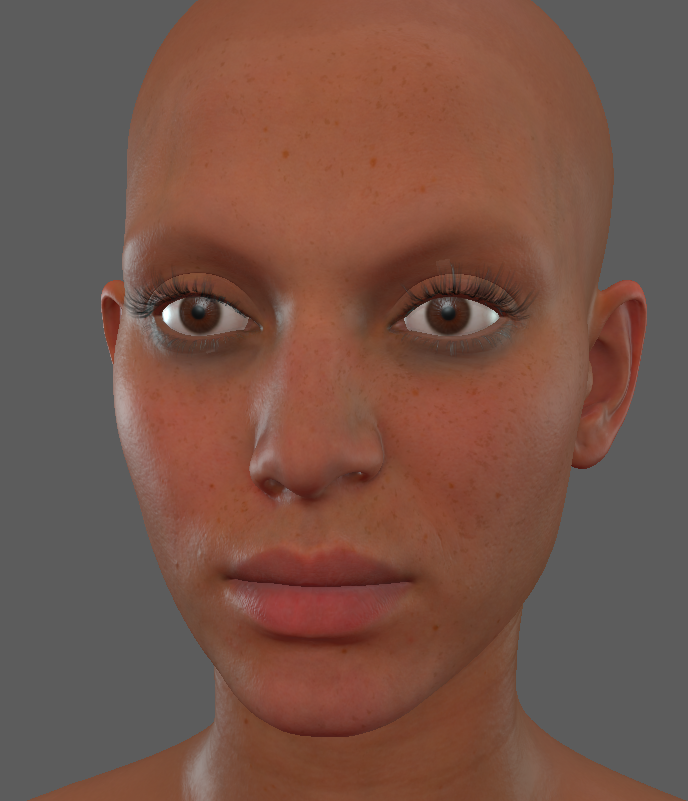
If you pose muscles too weakly or subtlely, you will not achieve a good range of movement. This is because the pose represents the maximum displacement, not some average displacement. Although in actual animation you will probably never encounter the muscle contracted to 100%, if the maximum displacement is not truly maximum, then by extension all lesser degrees of muscle contraction will be weaker looking than they should be. Furthermore, highly expressive facial animation will be difficult to achieve because the muscles cannot form intense poses.
Minimize the pose complexity
Somewhat contrary to the goal of maximizing detail is the goal of minimizing complexity.
When setting up muscle poses, don’t use more animation targets when fewer will produce the same result. Try to avoid compounding sculpting errors in which some animation targets are used to cover up mistakes made with others. In such cases, the static pose may look ok, but the transition into and out of the pose may look chaotic. Make the pose sensible and natural by keeping in mind that this is a displacement pattern, not just a shape.